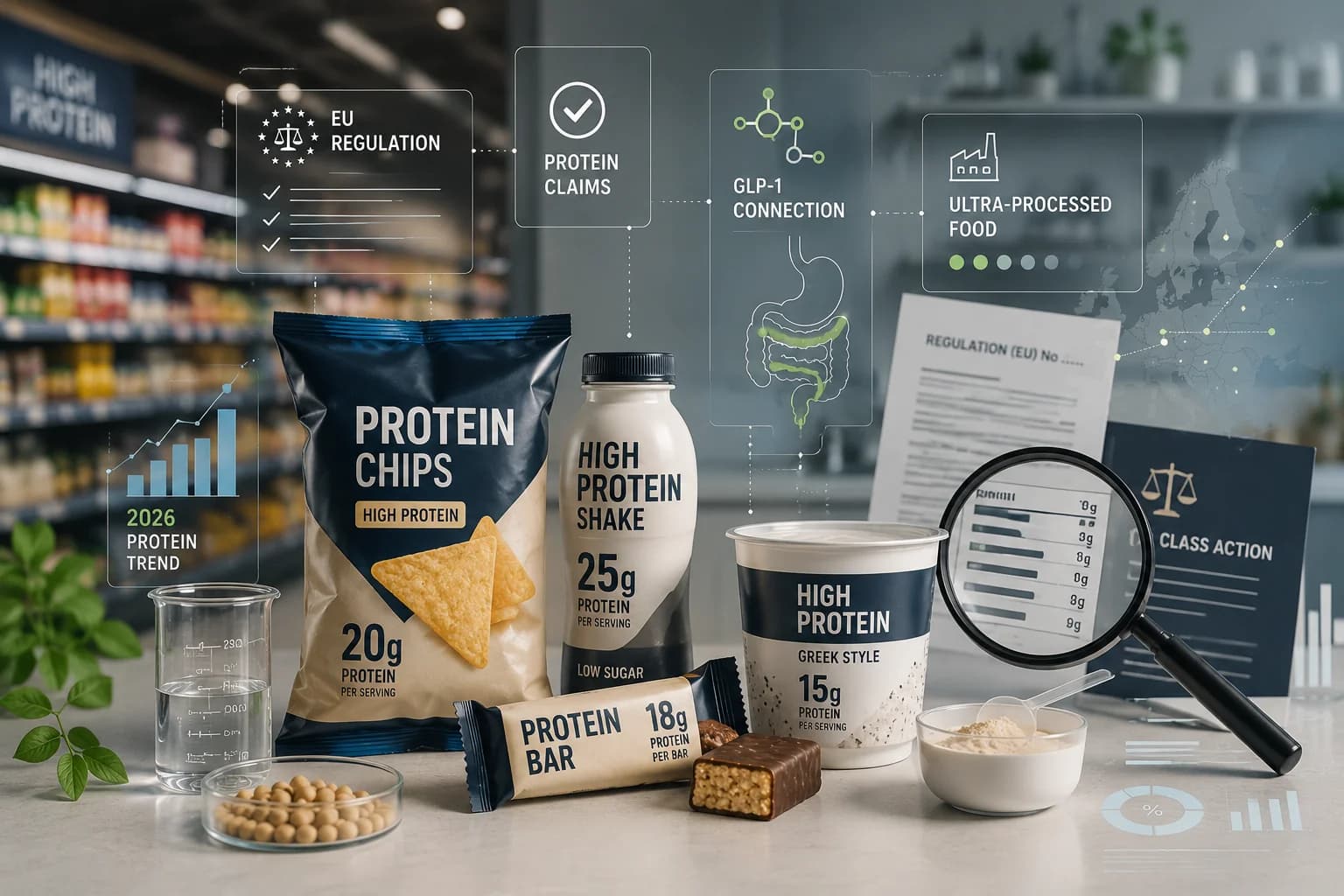
Recorre cualquier supermercado en 2026 y la proteína está prácticamente en todo. Las barritas, obviamente. Pero también en las patatas fritas, los cereales, el yogur, el helado, la leche, el pan, la pasta, los platos preparados y ahora los refrescos. La cifra de la parte frontal del envase — 20 g, 25 g, 30 g — se ha convertido en su propia moneda de marketing, y en Europa, Norteamérica y cada vez más Asia, los consumidores están comprando. Alrededor del 86 % de los adultos estadounidenses dicen que intentan activamente comer más proteína, y los datos europeos de Innova y FrieslandCampina muestran cifras similares, sobre todo entre la generación Z y los millennials.
Así que aquí va la pregunta incómoda que vale la pena hacerse: ¿qué hay realmente en esos productos, más allá de la cifra de proteína? Porque la respuesta, en muchos de ellos, es bastante.
¿Por qué la proteína está en todo en 2026?
La tendencia de la alta proteína es la historia alimentaria dominante de 2026 porque están ocurriendo tres cosas a la vez. La demanda de los consumidores ha pasado de «bajo en grasa» y «bajo en carbohidratos» a «alto en proteína» como señal de salud por defecto. Los fármacos GLP-1 para perder peso (Ozempic, Wegovy, Mounjaro) empujan a sus usuarios hacia comidas más pequeñas y densas — la proteína ayuda con la saciedad y la retención muscular durante la pérdida de peso. Y los fabricantes han descubierto que «alto en proteína» es uno de los pocos reclamos que sobrevive a todas las modas dietéticas a la vez.
El resultado, como lo expresó un analista del sector en una conferencia de 2026: la proteína ha pasado de ser un reclamo premium a una expectativa de base. Doritos Protein de PepsiCo se lanzó a principios de 2026 con 10 g de proteína por ración de 28 g. Nestlé tiene platos preparados congelados altos en proteína. Danone impulsa shots de 10 g de proteína. Arla y FrieslandCampina están reformulando yogures y bebidas en toda su gama. Para finales de 2026, encontrar una gran categoría alimentaria sin una variante alta en proteína será más difícil que encontrar una con ella.
¿Qué significa realmente «alto en proteína» en una etiqueta?
Según la legislación alimentaria de la UE (Reglamento 1924/2006), un producto puede declararse «fuente de proteína» si al menos el 12 % de su energía procede de la proteína, y «alto contenido en proteína» si lo hace al menos el 20 %. El umbral es sobre la proporción de energía, no sobre los gramos absolutos — lo que tiene algunas consecuencias interesantes.
Un producto puede ser «alto en proteína» y, a la vez, ser alto en azúcar, sal, grasa saturada o aditivos, siempre que la proporción de proteína supere el 20 % de las calorías totales. Una barrita de proteína con 20 g de proteína y 25 g de azúcar sigue cumpliendo. También un cereal proteico con un azúcar añadido considerable. También una patata frita proteica cargada de aceite de semillas y aromas.
Esto no es un resquicio legal — la norma hace lo que se diseñó para hacer, que es comunicar un hecho nutricional concreto. El problema es el halo de salud que crea «alto en proteína». Los consumidores ven el reclamo y generalizan en exceso, asumiendo que el producto es saludable en general. Décadas de investigación sobre el comportamiento del consumidor muestran que este efecto es constante y predecible.
¿Qué hay realmente en muchos productos altos en proteína?
La respuesta honesta: depende del producto, pero la parte de atrás del envase a menudo se parece muy poco a la de delante.
Patrones habituales que cabe esperar en los productos proteicos ultraprocesados:
- Varias fuentes de proteína apiladas — aislado de proteína de leche, concentrado de proteína de suero, péptidos de colágeno, aislado de proteína de soja, aislado de proteína de guisante, a menudo tres o cuatro a la vez. No es malo en sí, pero es una señal de un procesamiento considerable.
- Polialcoholes y edulcorantes intensos — maltitol, eritritol, xilitol, sucralosa, acesulfamo-K, glucósidos de esteviol. Mantienen baja la cifra de calorías pero traen sus propias preguntas, incluidos efectos digestivos a las dosis usadas en algunas barritas.
- Emulgentes y espesantes — lecitina de soja, lecitina de girasol, mono y diglicéridos (E471), carragenano (E407), goma xantana (E415), goma gellan. A menudo cuatro o cinco emulgentes en un solo producto para lograr textura sin que se derrita, se separe o se quede rancio.
- Sustitutos del azúcar que no se llaman azúcar — glicerina (usada como humectante y edulcorante), polidextrosa, fibra de maíz soluble, alulosa, isomaltooligosacáridos. Todos aparecen en la columna de carbohidratos sin etiquetarse como azúcar.
- Sustitutos de la grasa — sobre todo el EPG (glicerol propoxilado esterificado). Reduce las cifras de calorías declaradas porque la grasa no es totalmente biodisponible. La demanda colectiva estadounidense en curso contra David Protein (presentada en enero de 2026) pone a prueba exactamente esta cuestión — la empresa dice que el EPG legítimamente no aporta toda su carga calórica; los demandantes dicen que las pruebas de bomba calorimétrica mostraron un contenido calórico real sustancialmente mayor que el que indican las etiquetas.
- Aromas, colorantes y reguladores de la acidez — fáciles de pasar por alto, pero una barrita de proteína puede superar los diez aditivos sin que nadie lo note.
Una barrita de proteína con ocho gramos de fibra y tres gramos de azúcar puede sonar genial hasta que lees la lista real y te das cuenta de que la fibra está fabricada, el dulzor viene de cuatro edulcorantes distintos, y la textura la mantiene unida un pequeño bosque de emulgentes.
¿Cómo puntúan los productos altos en proteína en el Nutri-Score?
Aquí es donde se pone interesante. El algoritmo del Nutri-Score actualizado de 2026 es más estricto con el azúcar, la sal y los edulcorantes sin azúcar, pero también premia la proteína en el cálculo base — lo que significa que los productos altos en proteína a menudo puntúan mejor de lo que su carga de aditivos por sí sola sugeriría.
El resultado es que dos barritas de proteína con listas de ingredientes muy distintas pueden acabar ambas con un Nutri-Score B. Una es genuinamente una opción razonable; la otra es ingeniería con ropa de salud. El Nutri-Score es un punto de partida útil, pero para los productos altos en proteína en concreto, vale la pena mirar más allá de la letra.
Cómo leer la parte de atrás de un envase alto en proteína en 30 segundos
Algunas comprobaciones rápidas que se sostienen en todas las categorías:
- Cuenta las fuentes de proteína. Una o dos es típico de los productos menos procesados (yogur griego, huevos, kwark, leche natural). Cuatro o más suele señalar un producto muy diseñado.
- Mira azúcares y edulcorantes juntos. Una barrita «baja en azúcar» con varios edulcorantes intensos y tres polialcoholes no es realmente más baja en carga dulce — solo se ha redirigido.
- Cuenta los aditivos. Un producto alto en proteína genuinamente simple (requesón, skyr natural, huevo duro) no tiene ninguno. Cinco o más emulgentes, estabilizantes y aromas es un marcador de lo procesado que está el producto.
- Compara la densidad de proteína con las calorías totales. Una ración de 100 g con 20 g de proteína y 400 calorías es más densa que una ración de 60 g con 18 g de proteína y 220 calorías — un encuadre útil para la saciedad.
- Comprueba qué es realmente la proteína. La proteína de alimentos integrales (lácteos, huevos, legumbres, pescado, carne) se digiere de forma distinta a los aislados. Ambas tienen su lugar; no son intercambiables.
Una app escáner como Nime hace esto más rápido — escanea el código de barras, ve la lista de ingredientes agrupada por categoría (fuentes de proteína, edulcorantes, emulgentes, aromas), y compara dos productos del mismo estante sin tener que leer cada etiqueta a mano.
Proteína de alimentos integrales frente a productos proteicos diseñados
El encuadre más importante que la conversación sobre la proteína suele saltarse: no toda la proteína de tu dieta tiene que venir de un «producto proteico».
Una ración de 200 g de skyr o kwark natural contiene unos 20 g de proteína, viene con calcio y vitaminas del grupo B, y tiene una lista de ingredientes de una o dos líneas. Un huevo cocido aporta unos 6 g, sin lista de ingredientes alguna. Una porción de 150 g de garbanzos cocidos aporta unos 14 g de proteína más 12 g de fibra. Ninguno de estos necesita un reclamo de marketing para ofrecer lo que vende la barrita, y la mayoría son más baratos por gramo de proteína que la versión diseñada.
El encuadre del sector en 2026 — «la proteína como expectativa de base» — es genuinamente útil como objetivo nutricional. Solo que de ahí no se sigue que cada gramo de proteína de tu dieta tenga que venir de un producto diseñado para parecer proteína.
Preguntas frecuentes
¿Cuánta proteína necesito realmente al día?
La recomendación general de la UE para adultos es de aproximadamente 0,83 g por kg de peso corporal al día — unos 58 g para un adulto de 70 kg. Las personas activas, los adultos mayores y las personas que toman medicamentos GLP-1 a menudo se benefician de más (1,2 a 1,6 g/kg). La mayoría de los adultos en Europa Occidental ya alcanzan o superan el nivel base con una dieta normal sin productos proteicos específicos, algo que conviene saber antes de adoptar una rutina que añade una barrita al día.
¿Son malos los productos altos en proteína?
No de forma inherente. La proteína en sí está bien. El problema es que «alto en proteína» te informa sobre un nutriente, no sobre el resto del producto. Algunos productos altos en proteína son opciones genuinamente buenas — quark alto en proteína, yogur griego natural, edamame, pescado en lata. Otros son aperitivos ultraprocesados con una cifra de proteína pegada en la parte de delante. La norma de etiquetado los trata por igual; la parte de atrás del envase no.
¿Por qué tantos productos proteicos tienen varios edulcorantes?
Los edulcorantes cumplen funciones concretas en la formulación. Los polialcoholes como el eritritol y el maltitol aportan volumen y dulzor a un menor coste calórico; los edulcorantes intensos como la sucralosa y los glucósidos de esteviol aportan dulzor sin volumen. Combinarlos permite a los fabricantes alcanzar un perfil de dulzor concreto sin añadir azúcar — a costa de una lista de aditivos más larga.
¿De qué va la demanda contra David Protein?
Una demanda colectiva presentada en enero de 2026 alega que las barritas David Protein contienen sustancialmente más calorías y grasa de las que indican sus tablas de información nutricional. La empresa defiende su etiquetado con el argumento de que su sustituto de la grasa (EPG) es en gran medida no biodisponible y, por tanto, no aporta todo el contenido calórico pese a dar valores más altos en pruebas de laboratorio. El caso sigue pendiente y gira en torno a una disputa técnica genuina sobre cómo medir las calorías de ingredientes no biodisponibles — pero es una ilustración útil de lo complicadas que pueden ser las cifras de la etiqueta en productos diseñados.
¿Cuál es la forma más fácil de encontrar productos altos en proteína genuinamente buenos?
Escanea el código de barras y mira la parte de atrás del envase. Una app escáner como Nime divide la lista de ingredientes en categorías (fuente de proteína, edulcorantes, aditivos, aceites) para que puedas comparar productos lado a lado en segundos sin tener que leer cada etiqueta por completo. Combina eso con la prueba sencilla de si reconoces los ingredientes como comida, y los productos adecuados suelen volverse evidentes.
Fuentes: Innova Market Insights, Top Trends 2026; FrieslandCampina Ingredients, informe de tendencias 2026; comentarios de Arla Foods Ingredients; Lopez et al. contra Linus Technologies, Inc. (S.D.N.Y., presentada el 23 de enero de 2026); Reglamento (CE) 1924/2006 sobre declaraciones nutricionales y de propiedades saludables; valores nutricionales de referencia para la proteína de la Autoridad Europea de Seguridad Alimentaria.